
The Hidden Cost of Advisors Who Don’t Talk to Each Other
August 12, 2026
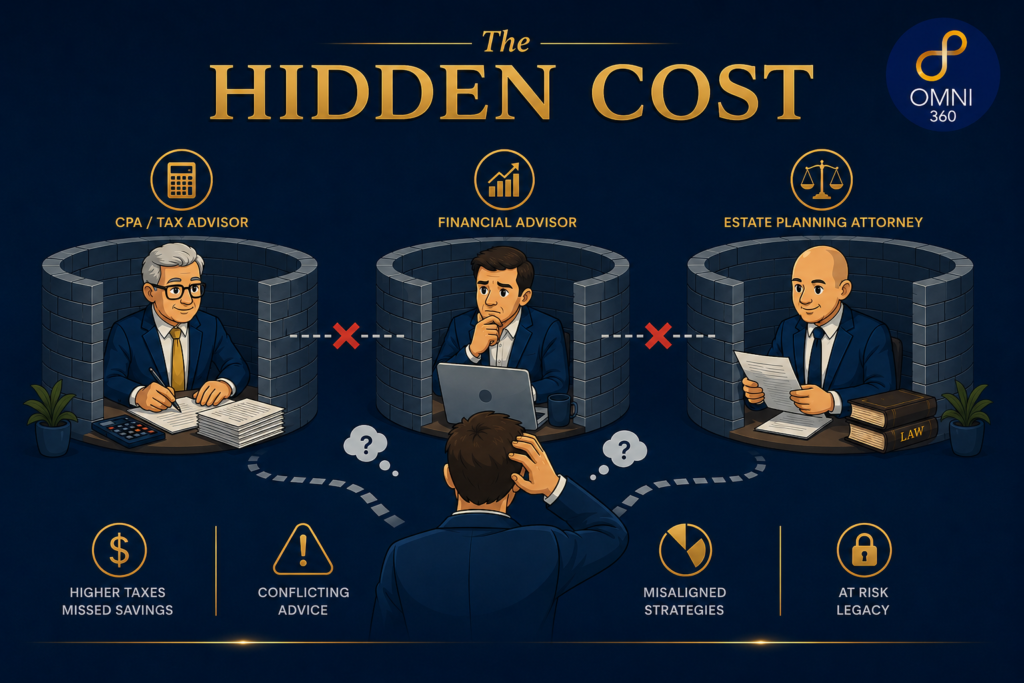
Financial decisions rarely happen in isolation. Learn how coordination among your financial advisor, CPA, estate attorney, and insurance professional can help create a more connected financial strategy.
For many successful business owners and families, assembling a strong team of professionals is an important part of managing financial complexity. You may have an experienced CPA, a trusted financial advisor, an estate-planning attorney, and an insurance professional.
Each may be highly capable in their own area.
The problem arises when each professional is making recommendations without knowing what the others are doing.
Your financial life does not operate in separate departments. A tax decision can affect your investment strategy. An estate-planning change can affect business ownership. An insurance decision can influence liquidity available to your family. And a business transaction can affect nearly every part of your financial plan at once.
That is why coordination matters.
Good Advice Can Still Conflict
The challenge is not necessarily receiving bad advice. In many cases, each professional may be making a reasonable recommendation based on the information available to them.
The conflict occurs when no one is looking across the entire financial picture.
Consider a business owner preparing for a sale. The transaction may involve decisions about deal structure, taxes, investment planning, estate planning, charitable giving, insurance, and future cash-flow needs.
If those conversations happen independently, important opportunities, tradeoffs, or timing considerations may be identified too late.
Coordination allows the professionals involved to understand how one decision may affect another before major steps are taken.
A Tax Decision Is Rarely Just a Tax Decision
Taxes are an important consideration, but minimizing taxes in one area does not automatically mean a decision is appropriate for the overall financial plan.
For example, a retirement-account distribution strategy may affect taxable income, future cash flow, investment allocation, charitable planning, and estate objectives.
Similarly, a business owner considering a tax strategy before a liquidity event may also need to evaluate how that strategy interacts with ownership structures, trusts, gifting plans, or future investment needs.
When tax planning and financial planning occur separately, each professional may see only part of the equation.
Estate Planning Can Affect More Than Your Estate
Estate documents are sometimes treated as something to create, sign, and revisit years later.
But life and wealth change.
A business may grow substantially. A company may be sold. Children become adults. Family circumstances evolve. Assets move between accounts or entities. Insurance policies change.
An estate plan that made sense several years ago may no longer reflect how assets are currently owned or how the family intends them to pass.
That is why estate planning should connect with financial planning, tax planning, insurance, and business succession conversations.
The documents are one part of the process. Making sure the broader financial picture aligns with those documents is equally important.
Insurance Should Fit the Broader Strategy
Insurance decisions can also become disconnected from the rest of the plan.
A policy may have been purchased years ago for a specific purpose, such as income replacement, estate liquidity, business succession, or family protection.
As circumstances change, the original purpose may change as well.
Reviewing insurance within the broader planning process can help determine whether existing coverage still aligns with current assets, liabilities, family priorities, business interests, and estate-planning objectives.
The question is not simply whether someone owns insurance. It is whether that insurance still has a clearly defined role within the overall plan.
The Value of a Shared Playbook
For families with significant financial complexity, coordination does not mean every professional needs to perform every function.
Quite the opposite.
CPAs, attorneys, financial advisors, and insurance professionals each bring different expertise to the table. The goal is to make sure those areas of expertise are connected.
That may mean sharing relevant information, discussing major decisions before they are implemented, identifying areas where strategies overlap, and clarifying which professional is responsible for each next step.
The result is a planning process built around the client’s entire financial life rather than a collection of isolated recommendations.
Is Your Advisory Team Connected?
As your wealth, business interests, and family responsibilities grow, the number of professionals involved in your financial life may grow as well.
A useful question is no longer simply:
“Do I have good advisors?”
It is also:
“Are my advisors working from the same playbook?”
At Omni 360 Advisors, our planning approach is designed around the interconnected nature of financial decisions. We help clients organize the different pieces of their financial lives and facilitate coordination among the professionals involved in their broader planning.
If your financial strategy currently lives in several different offices, it may be worth starting a conversation about how those pieces fit together.
This blog was developed with the assistance of AI-based tools for research, drafting and editing support (ChatGPT), and reviewed by OMNI 360 personnel for accuracy and relevance. The information provided is educational and general in nature and is not intended to be, nor should it be construed as, specific investment, tax, or legal advice.




