
The 5 Financial Decisions You Should Review Every Year—Even When Nothing Has Changed
August 24, 2026
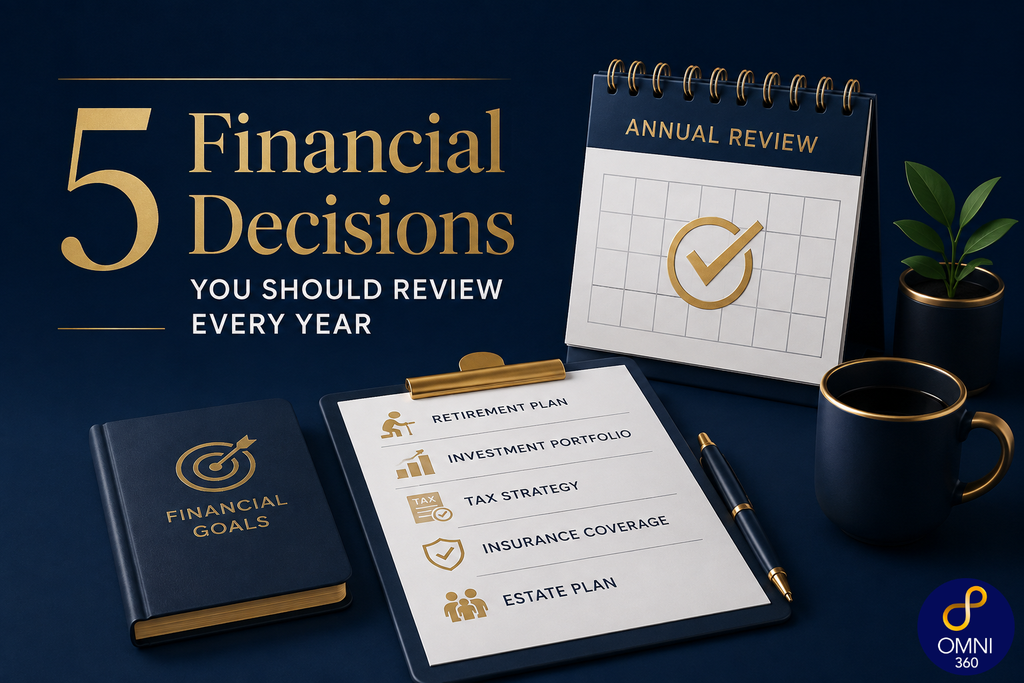
An annual financial review can help keep your tax strategy, investments, insurance, estate plan, beneficiaries, and retirement goals aligned with your life and priorities.
Financial planning often gets the most attention when something changes—a business is sold, a family grows, markets become volatile, or retirement moves closer. But some of the most important financial decisions deserve attention even during years when life feels relatively uneventful.
Tax laws evolve. Account values change. Insurance needs shift. Estate documents age. Beneficiary designations can become outdated. And retirement assumptions that seemed reasonable several years ago may no longer reflect your current circumstances.
For business owners, high-net-worth individuals, and multigenerational families, an annual financial checkup provides an opportunity to make sure the different pieces of a financial plan continue to work together.
Here are five areas worth reviewing every year.
1. Tax Planning and Your Overall Tax Picture
Tax planning should be an ongoing process rather than an activity reserved for filing season.
Each year, review your expected income, deductions, charitable giving, investment activity, business income, and other significant financial events. Business owners may also want to consider how compensation, retirement-plan contributions, estimated taxes, and business distributions fit into their broader personal financial picture.
The purpose of an annual tax review is not necessarily to make changes. It is to identify opportunities or potential issues early enough to evaluate them thoughtfully with your tax and financial professionals.
2. Your Investment Strategy
Even if you have not intentionally changed your portfolio, market movements may have changed it for you.
Strong performance in one asset class can cause your allocation to drift from its original targets. A concentrated stock position may become a larger portion of your wealth. Meanwhile, changes in your income, liquidity needs, time horizon, or comfort with risk may affect whether your existing strategy still fits.
An annual review can include asset allocation, diversification, account location, liquidity needs, and how investments relate to other assets such as a closely held business, real estate, or concentrated equity holdings.
The goal is not to react to every market movement. It is to determine whether your portfolio continues to reflect your broader financial objectives.
3. Insurance Coverage
Insurance can easily become a “set it and forget it” part of a financial plan. That can be a problem when personal circumstances and asset values change over time.
Review life, disability, property and casualty, umbrella liability, and long-term care coverage as applicable. Consider whether coverage amounts, ownership structures, beneficiaries, and policy purposes still reflect your current situation.
Business owners may have additional considerations involving key-person coverage, buy-sell arrangements, or policies connected to business succession planning.
An annual review can help identify gaps, unnecessary overlap, or policies that no longer serve the purpose for which they were originally purchased.
4. Estate Documents and Beneficiary Designations
A well-drafted estate plan can become outdated without anyone noticing.
Review wills, trusts, financial powers of attorney, healthcare directives, and other important documents periodically, particularly after major family, financial, or business changes. Even when documents remain appropriate, it is helpful to confirm that the people named to serve as trustees, executors, agents, or guardians are still suitable choices.
Beneficiary designations deserve separate attention. Retirement accounts, life insurance policies, and certain other assets may transfer according to beneficiary forms rather than instructions contained in a will.
For families focused on multigenerational planning, this annual review is also an opportunity to consider whether estate-planning structures still reflect family goals, asset ownership, and intended legacy.
5. Your Retirement Plan
Retirement planning is built on assumptions, and assumptions change.
Review your projected spending, savings rate, retirement contributions, expected retirement date, potential income sources, and liquidity reserves. Business owners should also consider how the value and eventual transition of the business fit into the retirement plan rather than assuming the business will automatically provide the necessary liquidity.
For individuals already retired, the review may focus more heavily on distributions, cash reserves, taxes, portfolio withdrawals, charitable objectives, and estate-planning priorities.
Small adjustments made periodically may be easier to evaluate than waiting until a major change forces a complete reassessment.
Make the Annual Review a Habit
A financial plan is not simply a collection of investments, insurance policies, tax returns, and legal documents. Each decision can affect the others.
That is why an annual review can be valuable even when there has been no dramatic change in your life. The objective is not to manufacture activity. It is to confirm that your financial decisions remain coordinated with your current circumstances, priorities, and long-term goals.
At Omni 360 Advisors and Omni Legacy Law, we help individuals, business owners, and families think through the financial and legacy decisions that often intersect across different areas of their lives. If it has been some time since you reviewed your broader plan, an annual checkup can provide a useful framework for conversations with your financial, tax, and legal professionals.
This blog was developed with the assistance of AI-based tools for research, drafting and editing support (ChatGPT), and reviewed by OMNI 360 personnel for accuracy and relevance. The information provided is educational and general in nature and is not intended to be, nor should it be construed as, specific investment, tax, or legal advice.




