
Bear vs. Bull Markets: What Retirees Need to Know to Navigate Market Cycles
April 8, 2026
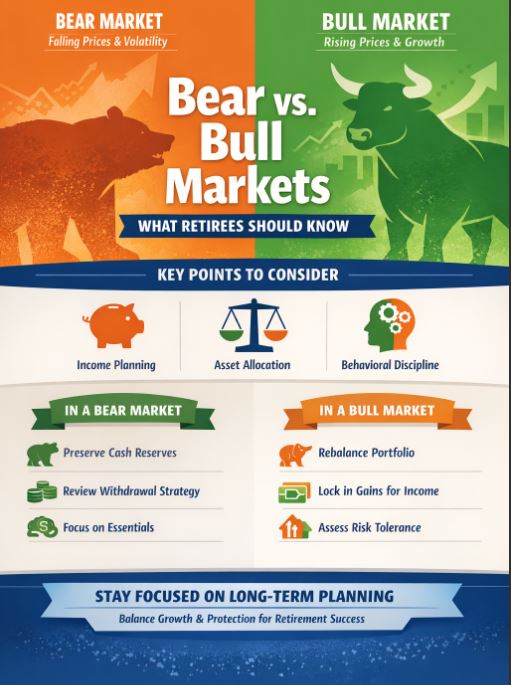
Market cycles are a natural part of investing—but for retirees, they carry a different weight. Unlike those in accumulation years, retirees are often drawing income from their portfolios, making market volatility more than just a temporary concern. Understanding the difference between bull and bear markets—and how each can affect retirement planning—is essential for preserving financial stability and long-term confidence.
What Defines a Bull and Bear Market?
A bull market is generally characterized by rising asset prices, strong investor confidence, and economic expansion. During these periods, portfolios often grow, and retirees may feel more comfortable with equity exposure.
In contrast, a bear market typically involves a decline of 20% or more in major indices, accompanied by economic uncertainty and reduced investor sentiment. These periods can test even well-constructed retirement plans.
While both environments are temporary, their impact can vary significantly depending on timing—especially for retirees withdrawing assets.
Why Market Cycles Matter More in Retirement
For retirees, the sequence of returns matters just as much as the returns themselves. Experiencing a bear market early in retirement—while taking withdrawals—can create what’s known as sequence of returns risk.
This risk arises when:
- Portfolio withdrawals coincide with market declines
- Assets are sold at lower values to generate income
- The portfolio has less opportunity to recover over time
Even if markets eventually rebound, the early depletion of assets can have lasting effects on portfolio longevity.
Key Considerations for Retirees
1. Income Planning Becomes Critical
During bull markets, portfolio growth can help support withdrawals. However, in bear markets, relying solely on investment sales for income may not be ideal.
A thoughtful income strategy often includes:
- Diversified income sources (e.g., Social Security, dividends, fixed income)
- Maintaining a cash reserve or short-term bucket
- Avoiding forced sales during downturns when possible
2. Asset Allocation Should Reflect Risk Tolerance
While growth remains important, retirees often benefit from a balanced allocation that considers both income needs and downside protection.
This may involve:
- A mix of equities and fixed income
- Exposure to less correlated assets
- Periodic rebalancing to maintain target allocations
Importantly, asset allocation should align with individual goals, time horizon, and comfort with volatility.
3. Behavioral Discipline Matters
Market volatility can trigger emotional decisions—especially during bear markets. Reacting impulsively to short-term declines may lead to unintended consequences.
A disciplined approach typically includes:
- Staying aligned with a long-term strategy
- Avoiding market timing decisions
- Reviewing plans periodically rather than reacting to headlines
Practical Strategies Across Market Cycles
During Bull Markets
- Reassess portfolio risk levels
- Consider rebalancing to avoid overexposure to equities
- Evaluate whether gains can support future income needs
Bull markets can create opportunities to strengthen a portfolio’s foundation rather than simply increasing risk.
During Bear Markets
- Focus on liquidity and income sources
- Review withdrawal strategies
- Evaluate whether adjustments are needed based on long-term goals
While downturns can be uncomfortable, they are also expected components of long-term investing.
The Role of Planning and Perspective
No one can predict exactly when markets will rise or fall. However, retirees can prepare by building a plan that accounts for both scenarios.
A well-structured retirement plan typically:
- Incorporates multiple income streams
- Balances growth with preservation
- Accounts for market variability
- Is reviewed and adjusted over time
As highlighted in broader regulatory and industry discussions, marketing and communication around investment strategies must remain fair, balanced, and not misleading—particularly when discussing potential benefits without fully addressing risks . This principle applies equally to how retirees evaluate their own financial decisions.
Bull and bear markets are inevitable—but their impact on retirement outcomes can vary widely depending on preparation and strategy. For retirees, the focus often shifts from maximizing returns to sustaining income, managing risk, and maintaining flexibility.
A proactive, well-informed approach can help navigate both market environments with greater clarity and confidence.
The information provided is educational and general in nature and is not intended to be, nor should it be construed as, specific investment, tax, or legal advice.




