
Top 5 Things Employers Should Know About Their 401(k) and Employer-Sponsored Retirement Plans
March 2, 2026
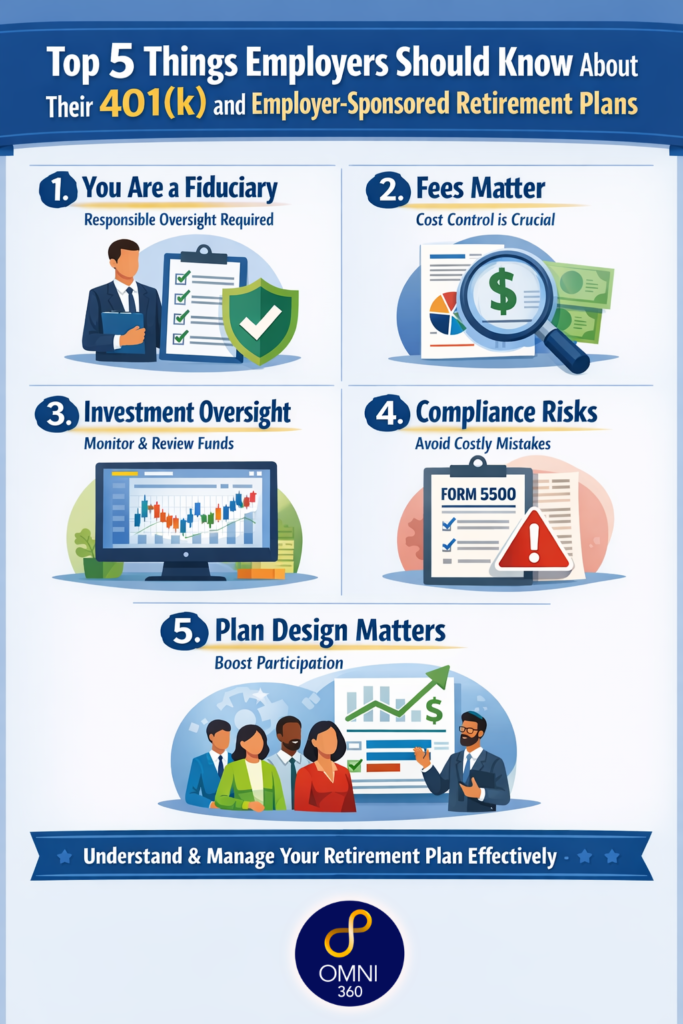
Discover the top five things business owners should understand about managing a 401(k) or employer-sponsored retirement plan, including fiduciary responsibility, fees, compliance, and employee engagement.
For many business owners, a 401(k) plan begins as a benefit designed to attract and retain talent. Over time, however, it becomes something much more significant: a fiduciary responsibility, a regulatory obligation, and an important component of your company’s financial culture.
Whether you oversee a growing company or a mature enterprise, understanding how your retirement plan operates—and where risks and opportunities may exist—is essential. Below are five key areas every employer should understand about managing an employer-sponsored retirement plan.
1. You Are a Fiduciary (Even If You Hire Experts)
As the plan sponsor, you serve as a fiduciary under ERISA. That means you are legally obligated to act in the best interests of plan participants.
Hiring a third-party administrator (TPA), recordkeeper, or financial advisor can help manage responsibilities—but it does not eliminate your oversight duty. You are responsible for prudently selecting and monitoring service providers, ensuring fees are reasonable, and confirming that the plan operates according to its governing documents.
Practical step: Maintain documentation of your decision-making process. Regular committee meetings, investment reviews, and fee benchmarking can help demonstrate procedural prudence.
2. Fees Matter More Than You Think
Even small differences in plan fees can meaningfully impact long-term retirement savings for employees. As a fiduciary, you must ensure that plan fees are reasonable relative to the services provided.
This includes:
· Investment expense ratios
· Recordkeeping and administrative fees
· Advisory or consulting fees
· Revenue sharing arrangements
Understanding both direct and indirect compensation structures is critical. Fee transparency has become an increasing area of regulatory focus, and employers are expected to actively evaluate cost structures.
Practical step: Conduct periodic fee benchmarking or request a fee analysis to compare your plan against similar-sized plans.
3. Investment Lineup Oversight Is Ongoing
Selecting a strong investment lineup is only the beginning. Ongoing monitoring is required.
Employers should:
· Review fund performance relative to benchmarks
· Evaluate consistency with stated investment objectives
· Assess risk characteristics
· Replace underperforming or unsuitable funds when appropriate
An Investment Policy Statement (IPS) can help formalize this process. While not legally required, an IPS provides structure and demonstrates a disciplined oversight framework.
Practical step: Review investment performance at least quarterly and document any decisions regarding fund changes.
4. Compliance Failures Can Be Costly
Retirement plans are subject to detailed regulatory requirements, including nondiscrimination testing, contribution limits, eligibility rules, required notices, and Form 5500 filings.
Operational errors—such as late deposits of employee deferrals or improper eligibility tracking—can create fiduciary exposure and potential penalties. While TPAs assist with administration, employers remain responsible for ensuring the plan is operating properly.
Regular plan audits (for larger plans), internal compliance checklists, and timely remittance of contributions are critical risk management tools.
Practical step: Establish a compliance calendar and confirm responsibilities are clearly assigned within your organization.
5. Plan Design Impacts Employee Outcomes
Your plan design influences participation rates, savings behavior, and long-term retirement readiness.
Features that employers often evaluate include:
· Automatic enrollment
· Automatic escalation
· Employer matching formulas
· Roth options
· Profit-sharing contributions
Behavioral finance research suggests that thoughtfully designed plans can encourage higher participation and savings rates. At the same time, plan design decisions must align with company cash flow, workforce demographics, and long-term business objectives.
Practical step: Periodically review plan participation rates, average deferral percentages, and workforce engagement metrics to assess whether adjustments may be warranted.
A 401(k) plan is more than a workplace benefit—it is a fiduciary commitment and a strategic component of your organization’s long-term success. When properly structured and monitored, a retirement plan can support employee financial wellness while reinforcing your company’s values and leadership.
If you would like to review your current plan structure, fiduciary processes, or long-term retirement plan strategy, the team at Omni 360 Advisors is available to provide educational guidance and help you evaluate your options.
This blog was developed with the assistance of AI-based tools for research, drafting and editing support (ChatGPT), and reviewed by OMNI 360 personnel for accuracy and relevance. The information provided is educational and general in nature and is not intended to be, nor should it be construed as, specific investment, tax, or legal advice.




