
Understanding the K-Shaped Economy: Why Portfolio Diversification Matters More Than Ever
June 10, 2026
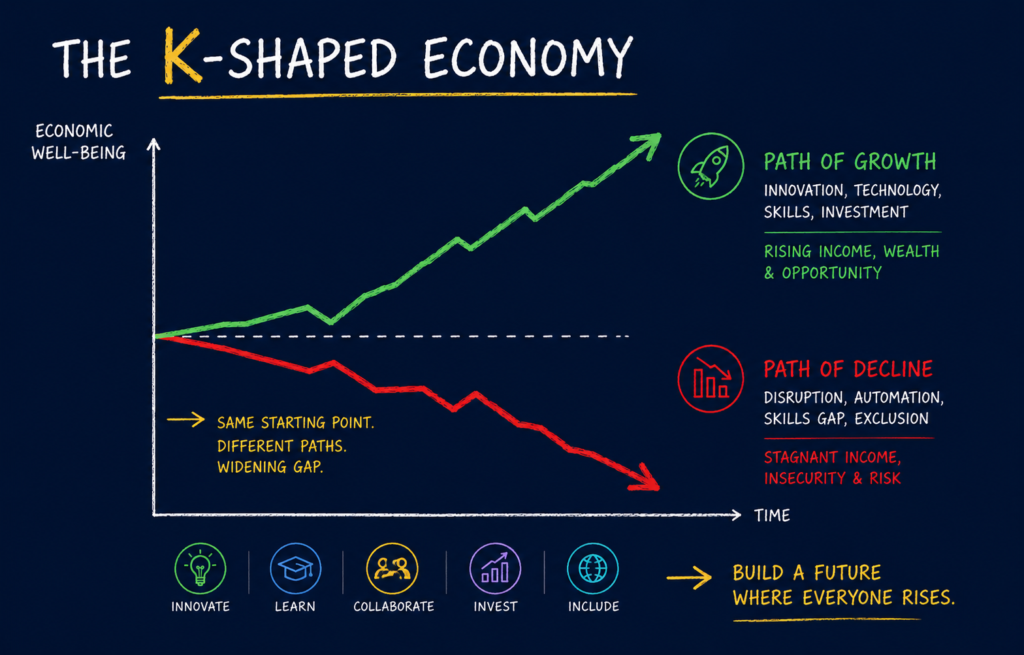
Learn what a K-shaped economy means, how it affects investors and business owners, and why maintaining a diversified portfolio may help navigate an increasingly uneven economic landscape.
The economy is often discussed as though everyone experiences the same recovery, growth cycle, or downturn. In reality, economic conditions can impact different industries, businesses, and households in very different ways. This phenomenon is often described as a K-shaped economy—a term that has become increasingly relevant in recent years.
For business owners, professionals, and families focused on preserving and growing wealth across generations, understanding the implications of a K-shaped economy can help inform long-term financial decisions. One of the key lessons is the continued importance of portfolio diversification.
What Is a K-Shaped Economy?
A K-shaped economy describes a situation where different parts of the economy move in opposite directions at the same time. The upper branch of the “K” represents sectors, businesses, and individuals experiencing growth and prosperity, while the lower branch represents those facing economic challenges or stagnation.
For example, technology, artificial intelligence, and certain healthcare sectors have experienced significant growth in recent years. Meanwhile, other industries may face labor shortages, rising costs, changing consumer behavior, or slower growth.
The result is an increasingly uneven economic environment where broad market headlines may not reflect the experiences of every investor or business owner.
Why This Matters for Investors
In a K-shaped economy, concentration risk can become more pronounced.
When a particular sector is leading market performance, investors may feel tempted to increase exposure to the areas generating the strongest returns. While that can seem logical in the short term, economic leadership often shifts over time.
History has shown that market leadership rotates. Industries that outperform during one cycle may lag during the next. Economic conditions, interest rates, innovation, regulation, and consumer preferences can all influence which sectors thrive and which face headwinds.
Because of these dynamics, investors may benefit from maintaining a broader perspective rather than focusing solely on recent winners.
The Role of Diversification
Diversification is a foundational investment principle designed to spread risk across multiple asset classes, sectors, and investment styles.
Rather than relying heavily on a single area of the market, a diversified portfolio may include exposure to:
- U.S. equities
- International equities
- Fixed income investments
- Alternative asset classes
- Real estate-related investments
- Cash and liquidity reserves
The objective is not to eliminate risk but to avoid having portfolio outcomes driven primarily by one investment theme or economic trend.
In a K-shaped economy, diversification can be especially valuable because different segments of the market may respond differently to changing conditions. Areas that struggle during one phase of the cycle may provide opportunities during another.
Beyond Public Markets
For many business owners and high-net-worth families, diversification extends beyond traditional stock and bond allocations.
Private business interests, real estate holdings, concentrated stock positions, and other illiquid assets can create significant wealth—but they can also increase concentration risk.
Following a liquidity event, business sale, inheritance, or major transition, families often find themselves heavily exposed to a limited number of assets. Thoughtful diversification planning may help create greater balance between growth opportunities and risk management objectives.
This process often involves evaluating how various assets interact within the broader wealth picture rather than viewing each investment in isolation.
Staying Focused on Long-Term Objectives
One of the challenges of a K-shaped economy is the constant flow of headlines highlighting the strongest-performing sectors and emerging trends.
While these developments can create opportunities, long-term success is often driven by maintaining a disciplined investment approach aligned with personal goals, risk tolerance, liquidity needs, and time horizon.
Rather than attempting to predict which branch of the economy will outperform next, investors may benefit from building resilient portfolios capable of adapting to changing conditions over time.
Final Thoughts
The K-shaped economy highlights an important reality: not all parts of the economy move together. As opportunities and challenges emerge across different sectors, diversification remains an important tool for managing uncertainty and pursuing long-term financial objectives.
For business owners, executives, and multigenerational families, regular portfolio reviews can help ensure that investment strategies remain aligned with evolving economic conditions and personal goals.
To learn more about building a diversified wealth strategy that reflects your broader financial picture, connect with the team at Omni 360 Advisors for an educational conversation about long-term planning and portfolio design.
This blog was developed with the assistance of AI-based tools for research, drafting and editing support (ChatGPT), and reviewed by OMNI 360 personnel for accuracy and relevance. The information provided is educational and general in nature and is not intended to be, nor should it be construed as, specific investment, tax, or legal advice.




