Large and In Charge? Giant Firms atop Market Is Nothing New
Schedule a meeting with a member of our advisory team
Large and In Charge? Giant Firms atop Market Is Nothing New
July 14, 2020
The world is changing, this crisis has cemented the dominance of a handful of very large technology companies (FAANG – Facebook, Amazon, Apple, Netflix, Google). Why shouldn’t investors just focus on them?
Investors may be surprised to learn that it is not unusual for the market to be concentrated in a handful of stocks, but keep in mind that any expectations about the future operational performance of a firm are already reflected in its current price.
Tech standouts are drawing attention for their perceived sway on stocks, but history undercuts that view.
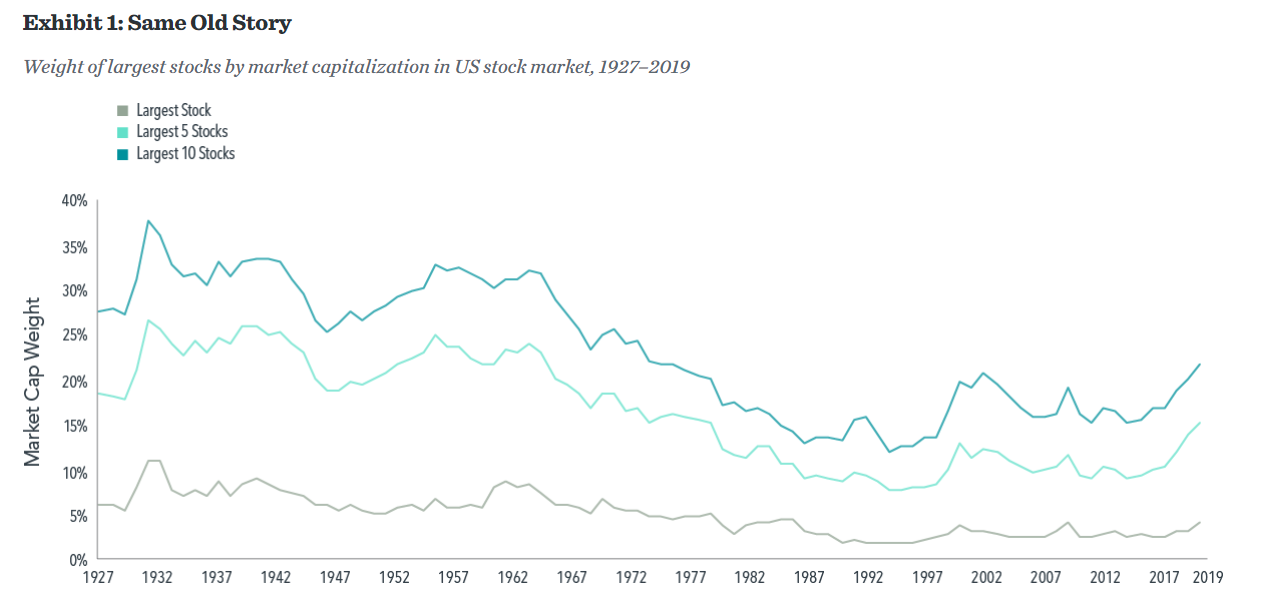
A top-heavy stock market with the largest 10 stocks accounting for over 20% of market capitalization and a marquee technology firm perched at No. 1? This sounds like a description of the current US stock market, dominated by Apple and the other FAANG stocks,1 but it is actually a reference to 1967, when IBM represented a larger portion of the market than Apple at the end of 2019 (5.8% vs. 4.1%).
As we see in Exhibit 1, it is not particularly unusual for the market to be concentrated in a handful of stocks. The combined market capitalization weight of the 10 largest stocks, just over 20% at the end of last year, has been higher in the past.
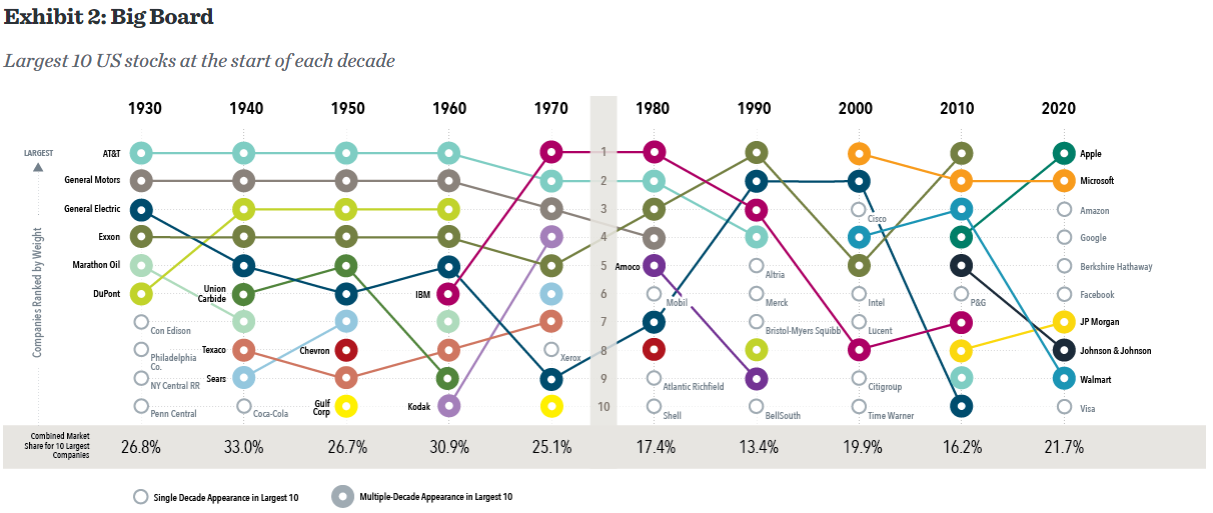
A breakdown of the largest US stocks by decade in Exhibit 2 shows some companies have stayed on top for a long time. AT&T was among the largest two for six straight decades beginning in 1930. General Motors and General Electric ranked in the top 10 at the start of multiple decades. IBM and Exxon were also mainstays in the second half of the 20th century. Hence, concentration of the stock market in a few large companies such as the FAANG stocks in recent years is not a new normal; it is old normal.
Moreover, while the definition of “high-tech” is constantly evolving, firms dominating the market have often been on the cutting edge of technology. AT&T offered the first mobile telephone service in 1946. General Motors pioneered such innovations as the electric car starter, airbags, and the automatic transmission. General Electric built upon the original Edison light bulb invention, contributing to further breakthroughs in lighting technology, such as the fluorescent bulb, halogen bulb, and the LED. So technological innovation dominating the stock market is not a new normal; it is an old normal too.
Another trend attributed to a new normal is the extraordinary performance of FAANG stocks over the past decade, leading some to wonder if we should expect these stocks to continue such strong performance going forward. Investors should remember that any expectations about the future operational performance of a firm are already reflected in its current price. While positive developments for the company that exceed current expectations may lead to further appreciation of its stock price, those unexpected changes are not predictable.
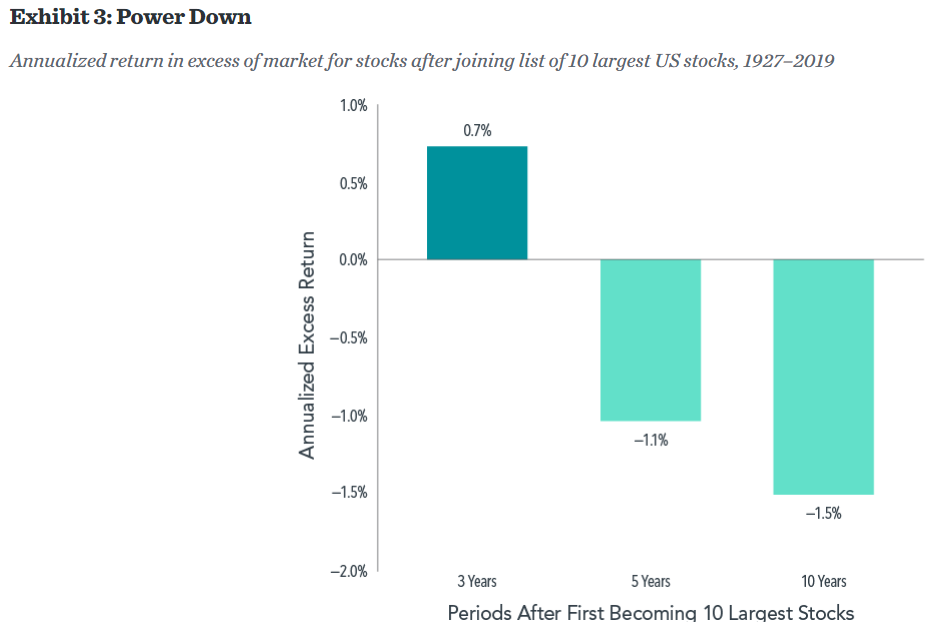
To this point, charting the performance of stocks following the year they joined the list of the 10 largest firms shows decidedly less stratospheric results. On average, these stocks outperformed the market by an annualized 0.7% in the subsequent three-year period. Over five- and 10-year periods, these stocks underperformed the market on average.
Past performance is no guarantee of future results.
The only constant is change, and the more things change the more they stay the same. This seems an apt description of the dominant stocks atop the market. While the types of businesses most prominent in the market vary through time, the fact that a small subset of companies’ stocks account for an outsized portion of the stock market is not new. And it remains impossible to systematically predict which large companies will outperform the stock market and which will underperform it. This underscores the importance of having a broadly diversified equity portfolio that provides exposure to a vast array of companies and sectors.
Sources: Dimensional Fund Advisors LP is an investment advisor registered with the Securities and Exchange Commission.
Original article can be found at https://us.dimensional.com/perspectives/large-and-in-charge-giant-firms-atop-the-market-is-nothing-new
Connect with us on Social Media using the following buttons:
Visit our Podcasts
Listen in, Join the Conversation!
Recent Posts
Top 5 Things Employers Should Know About Their 401(k) and Employer-Sponsored Retirement Plans
Discover the top five things business owners should understand about managing a 401(k) or employer-sponsored retirement plan, including fiduciary responsibility, fees, compliance, and employee engagement. ...
Health Care: The Hidden Retirement Cost You Can’t Afford to Ignore
Health care is one of the most significant and often underestimated retirement expenses. Explore Medicare, long-term care, and tax planning considerations for affluent families. When most people think about retirement planning, they focus on investment ...
The Risks of Concentrated Stock: Evaluating Single-Stock Exposure
A concentrated stock position can significantly impact portfolio risk and tax planning. Explore considerations for executives, founders, and business owners managing single-stock exposure. Success often creates complexity. For business owners, executives, ...
Omni 360 Advisors is an integrated financial services, legal planning, and accounting firm* committed to a 360 approach to creating and implementing powerful life and legacy plans for our clients long-term success.
We believe that understanding — and applying — the 27 principles in this book can help make you a more patient and — ultimately — successful long-term investor. We hope they will empower you to understand the difference between the noise (not useful information for your personal goals) and the science (relevant information for your personal goals).
This book is for all the ordinary people who have dedicated their lives to working and saving in order to achieve important goals such as providing for children’s education and enjoying a secure retirement. Life is complicated. Investing shouldn’t be.
🍪 We Use Cookies At Omni 360 Advisors, we use cookies to enhance your browsing experience, deliver personalized content, and analyze our website traffic. By clicking "Accept," you consent to the use of all cookies in accordance with our Privacy Policy.
Functional
Always active
The technical storage or access is strictly necessary for the legitimate purpose of enabling the use of a specific service explicitly requested by the subscriber or user, or for the sole purpose of carrying out the transmission of a communication over an electronic communications network.
Preferences
The technical storage or access is necessary for the legitimate purpose of storing preferences that are not requested by the subscriber or user.
Statistics
The technical storage or access that is used exclusively for statistical purposes.The technical storage or access that is used exclusively for anonymous statistical purposes. Without a subpoena, voluntary compliance on the part of your Internet Service Provider, or additional records from a third party, information stored or retrieved for this purpose alone cannot usually be used to identify you.
Marketing
The technical storage or access is required to create user profiles to send advertising, or to track the user on a website or across several websites for similar marketing purposes.
Omni 360 Advisors LLC
609-452-0889 | 877-623-2266
Integrated tax, legal, business & financial planning.
Redirect to Another Page
When you link to any of these websites provided here, you are leaving this site. We make no representation as to the completeness or accuracy of information provided on these sites.
Nor are we liable for any direct or indirect technical or system issues or consequences arising out of your access to or use of these sites.
When you access one of these sites, you are leaving our website and assume total responsibility for your use of the sites you are visiting.